

Blog Article
Planning Intelligence You Can Trust, Act On, and Explain: Meet the Next Generation of Blue Ridge
It's the Monday before the weekly review, and a planner has a week of buying and replenishment decisions to make. Before committing to any of them, three questions have to be settled: Can I trust the data under this plan? Can I see what needs my attention first? Can I understand what's driving this forecast well enough to stand behind it?
A forecast only gets used once a planner can answer those three questions, and the answers need to arrive before the decision, not after something goes wrong. AI raises the stakes on each one, because it puts more recommendations in front of planners, faster. Blue Ridge built the next generation of its platform to answer all three.
Can I trust the data?
A forecast is only as trustworthy as the data it starts from, and planners know it. When duplicate records, mismatched units, or a late ERP sync can reach the model unchecked, every output needs a second look, and the time automation was supposed to save goes to double-checking. Trust has to be structural, built into how data is handled before any model touches it.
Blue Ridge's data platform is built on Databricks and made up of composable components. Data from your ERP flows into the platform, gets cleansed and validated automatically, and lands in a single source of truth that every part of the platform draws from, with data quality monitored continuously. Compute scales elastically, so adding SKUs, locations, or scenarios happens without rework.
Can I see what needs my attention?
Planners rarely lack data. They lack the time to find the part of it that matters. Systems that put every number on the screen leave triage to the planner, and systems that send people to outside reporting tools to find the exceptions split the work across tabs and exports. Intelligence should narrow the field: bring forward what needs a decision before it becomes a problem, and say why a recommendation looks the way it does.
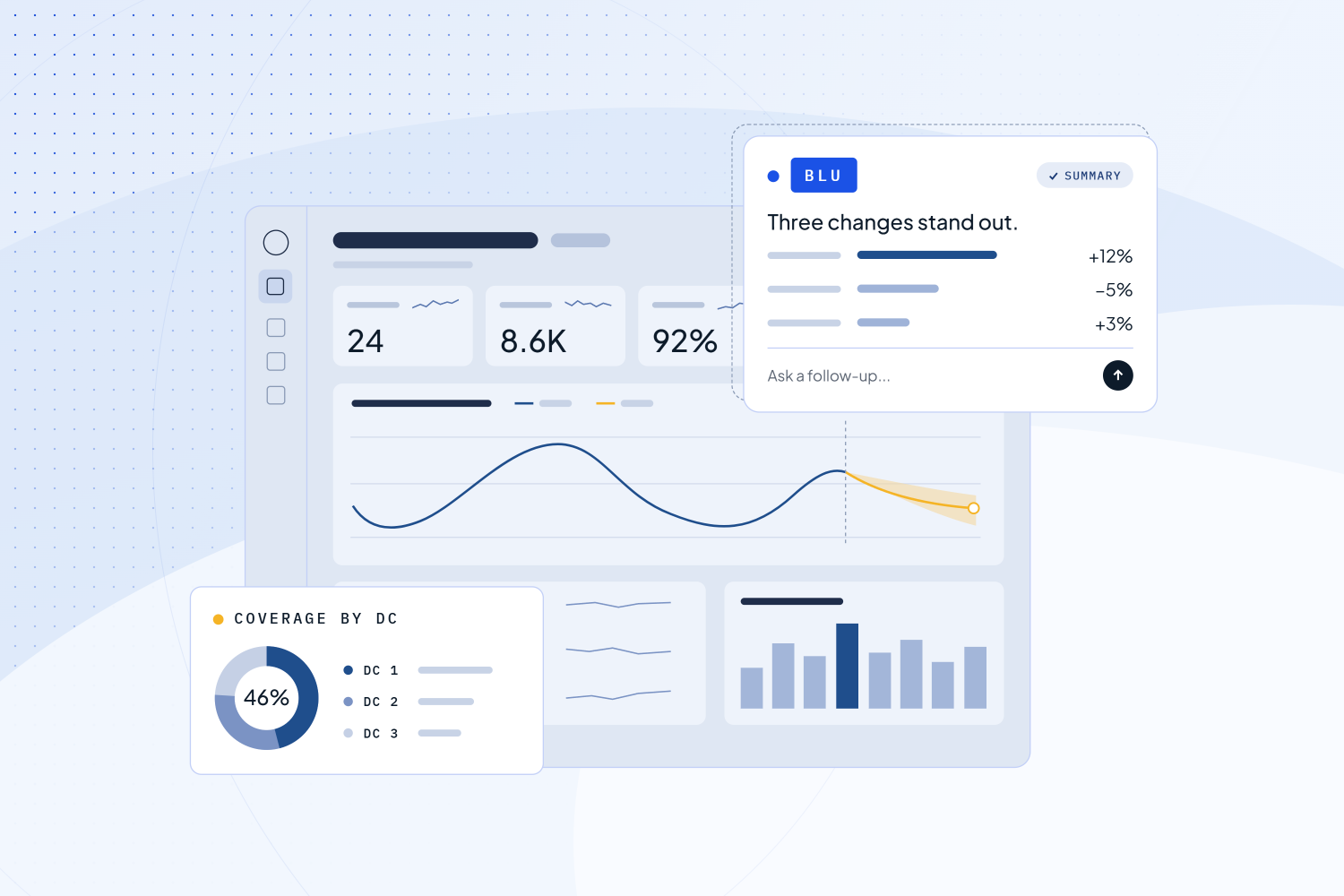
In Blue Ridge's configurable, no-code interface, each team sets what gets surfaced without an IT ticket, while IT governs access through roles and permissions. Forecasts, exceptions, and explanations sit in one place, and Blu, Blue Ridge's generative AI, explains the logic behind a forecast or replenishment recommendation in plain language. Before approving a recommendation, a planner can ask "Why does the forecast look this way?" and get an answer without leaving the work.
Can I understand the number?
Before a planner can defend a number to anyone, they have to understand it. A single forecast figure hides what shaped it: how much is seasonality, how much is a promotion, how much is a shift in price or weather. Acting with confidence, and later explaining the decision to finance or sales, starts with seeing what is driving the forecast. Understanding works best as part of the forecast itself, not a report added afterward.
The Adaptive ML Forecast Engine builds each forecast from its individual drivers, trend, seasonality, price, promotions, and external signals such as weather, and weights each one by how much it contributes to the number. It is a single model that learns across the entire portfolio, so slow-moving and newly launched items benefit from what it learns about similar items instead of relying on thin sales history alone. Because it incorporates live signals as they happen, forecasts respond to the conditions the business is operating in. And because the forecast is assembled from its drivers, the explanation is the forecast itself. A planner sees what is driving each number, and by how much, before acting on it, with no separate analysis.
Intelligence has to hold up at every layer
These three questions are really one: can I rely on this enough to act on it? A weakness in any layer undermines the other two. An explainable forecast built on data nobody trusts still gets second-guessed, and clean data inside a workspace that buries what matters still slows the planner down. That is what Supply Chain Intelligence means in practice: AI running through every layer, reasoning in plain view, and the decision left in the planner's hands.
Explore the next generation of supply chain planning.
You might also like

KEEP EXPLORING
Beyond the blog
Webinars when you have an hour. Guides and reports worth bookmarking. Customer stories you'll want to share. The full library is here.